Mars has ignited our collective imagination since humanity first gazed at the red dot in our night sky. From Asimov’s and Bradbury’s novels to the latest rover missions, the idea of exploring—and perhaps even settling—on Mars has seemed both inevitable and tantalizing. Yet today, as space agencies and private companies marshal unprecedented resources toward the Red Planet, we must ask: what makes Mars our next great frontier, and what challenges lie between Earth and a viable human presence on its barren surface?
Red Planet’s Allure
Mars appeals for several intertwined reasons. Its day length closely matches ours, reducing the circadian challenges that plague lunar missions. Its polar ice caps and subsurface ice deposits hint at water resources essential for drinking, agriculture, and fuel production. Moreover, Mars shares many geological features with Earth—valleys, volcanoes, and even seasons—offering a natural laboratory to study planetary evolution and the possibility of past life. These parallels, combined with its distance—close enough for communication but far enough to feel remote—fuel both scientific curiosity and the dream of becoming an interplanetary species.
Scientific Imperatives
Robotic landers and orbiters have already rewritten our understanding of Mars. The discovery of ancient riverbeds, clay minerals formed in water, and fluctuating methane levels suggests that Mars was once warmer and wetter. Scientists now aim to answer profound questions: Did primitive life ever arise on Mars? How did its climate transform so drastically? And how do we safeguard Earth by understanding planetary habitability? Upcoming sample-return missions—robots that collect Martian rock and soil for analysis on Earth—promise to deliver the most definitive answers yet. In this sense, Mars serves as our best shot at finding life beyond our planet, making it a scientific priority.
Technical and Human Challenges
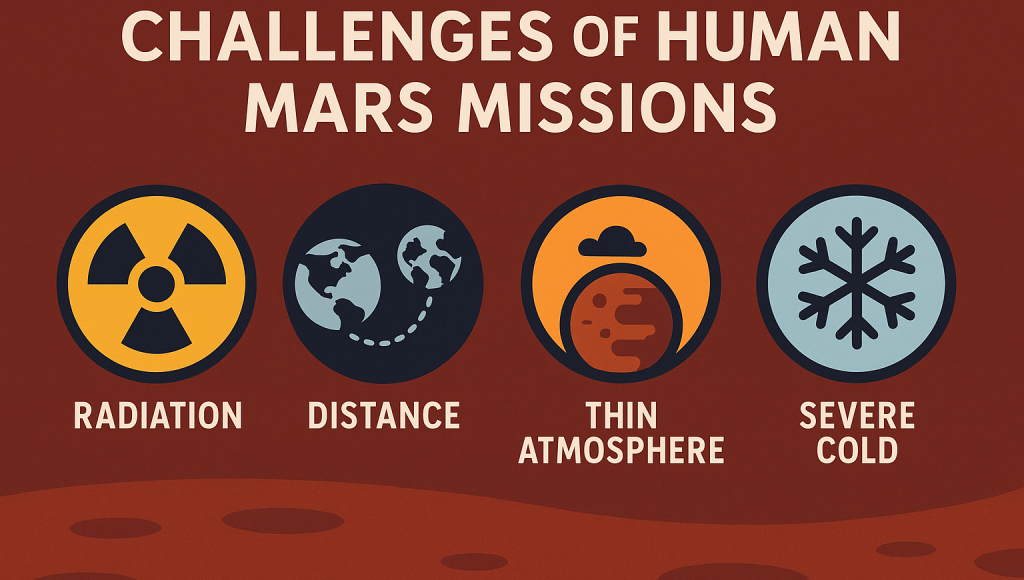
Reaching Mars is a triumph of engineering, but building a sustainable presence there requires grappling with extreme conditions. Radiation from cosmic rays and solar flares poses grave risks to astronauts' health over months-long voyages and extended surface stays. Low atmospheric pressure and frigid temperatures demand robust habitats with reliable life‐support systems. Launch windows to Mars occur only every 26 months, limiting mission flexibility. Even with in-situ resource utilization—turning Martian water ice into oxygen and fuel—designing the transport, extraction, and processing infrastructure strains current technology. Addressing these challenges will push innovation in habitat design, radiation shielding, closed-loop life support, and autonomous robotics.
Private Enterprise and International Collaboration
No single nation can shoulder the full cost and risk of human Mars missions. That is why public-private partnerships and multinational cooperation are vital. NASA’s Artemis program focuses on returning humans to the Moon as a proving ground, while SpaceX’s Starship aims for direct Mars transport. Europe’s ESA, Russia’s Roscosmos, China’s CNSA, and others pursue complementary robotic and orbital platforms. This network of shared expertise and resources accelerates progress and spreads risk—but it also raises complex questions of governance. Who claims Martian territory? How will we allocate scarce water ice? Crafting international agreements that balance scientific access, commercial interests, and planetary protection will test diplomacy as much as rocket science.
Ethical and Philosophical Dimensions
Beyond the technical, Mars colonization stirs deep ethical debates. Some argue that founding settlements on another planet represents the pinnacle of human aspiration, ensuring our species’ survival against existential threats to Earth. Others warn of repeating colonialist mistakes—imposing Earth-centric values on an alien world, exploiting resources without regard for intrinsic planetary heritage, or introducing terrestrial microbes that could irreversibly contaminate Martian ecosystems. Thoughtful stewardship demands that we define not only how to go to Mars, but why—and under what guiding principles.
Toward a Martian Future
Looking ahead, the path to Mars will unfold in stages. Continued robotic exploration will refine landing sites, map water‐ice reserves, and test resource extraction methods. Lunar missions will validate closed life‐support systems and human‐robotic collaboration in a harsh environment. Early crewed fly-bys or orbital missions around Mars could provide invaluable data on radiation exposure and crew health without the added complexity of landing. Only then might humans set foot on Mars, initially for short stays and scientific exploration. Over decades, small outposts could expand into larger habitats, potentially evolving into self-sustaining communities.
Conclusion
Mars embodies both the promise and the peril of venturing beyond our home planet. It's the red desert's call to our exploratory instincts and scientific curiosity. Yet transforming that call into a lasting human presence demands overcoming immense technical, logistical, ethical, and diplomatic obstacles. Whether Mars ultimately becomes the next frontier of human habitation or remains a remote laboratory for robotic explorers, the journey there will reshape our technology, our institutions, and perhaps our very understanding of what it means to be human. In striving for the Red Planet, we confront our most significant challenges and our highest hopes—making Mars not just another destination, but a defining quest for this century.
